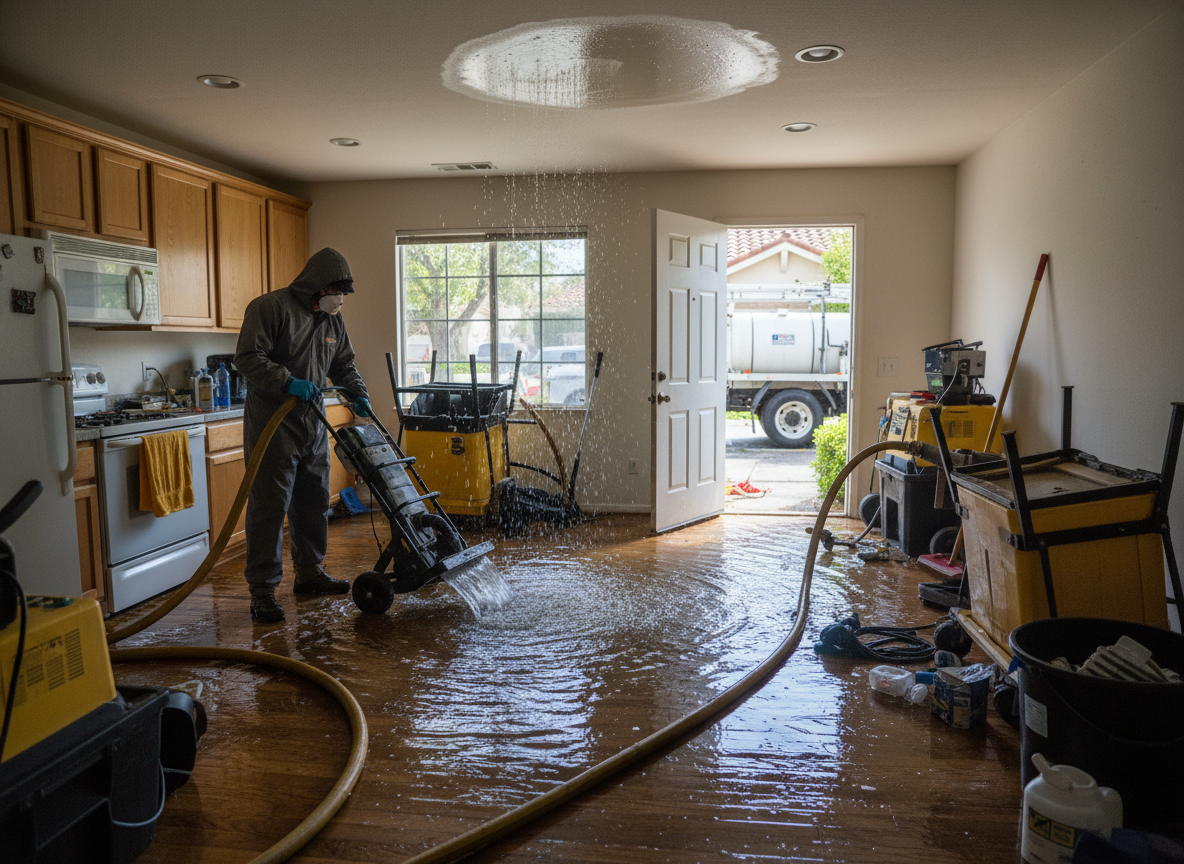
Laguna Woods Village homes, many built in the 1960s and 1970s, often feature slab-on-grade construction and shared plumbing stacks that allow even small leaks to travel under floors or between units. A slow drip from a supply line or drain can saturate particleboard subfloors or drywall before residents notice changes in the mild Mediterranean climate where evaporation rates stay low most of the year. Technicians must map moisture with meters across multiple rooms and sometimes into neighboring units because the concrete and stucco assemblies hide migration paths that do not appear in newer tract homes in nearby Laguna Hills.
Restoration crews working near the Laguna Woods Village Golf Courses routinely deal with irrigation overspray and seasonal drainage that pushes water against foundation edges during rare heavy rains. These conditions raise the risk of hidden saturation along slab perimeters, especially where original copper lines have developed pinhole leaks after decades of service. Proper drying requires placing air movers and dehumidifiers in patterns that account for the dense layout of the village rather than open single-family layouts common elsewhere in Orange County.
When a leak originates above a shared ceiling or in a wall cavity, removal of baseboards and selective drywall cuts become necessary to reach wet insulation without disturbing electrical or HVAC runs that run through the same spaces. Technicians document every step with photos because association rules in Laguna Woods Village often require proof that affected common areas were addressed before any repair work proceeds. Skipping these steps can leave residual moisture that later supports mold growth inside the wall cavities typical of the area's construction.
Technician insight
In Laguna Woods, the thing that catches most people out with Water leak restoration is how quickly water moves along the slab edges and under the stucco in Laguna Woods Village condos, especially near the golf courses where irrigation keeps the soil moist year-round.
Ceiling Leak Between Units
Water appeared on a first-floor ceiling in a Laguna Woods Village condo. Inspection traced the source to a second-floor bathroom supply line that had corroded. Extraction and drying equipment ran for four days across both units while moisture readings were tracked through the shared floor assembly.
How it works
- 1
On-Site Assessment
Technicians arrive within hours, locate the leak source, and use moisture meters to chart affected materials across the unit and any shared walls.
- 2
Water Extraction
Standing water is removed with portable extractors, followed by targeted drying equipment placed to reach slab edges and wall cavities common in Laguna Woods Village.
- 3
Drying and Monitoring
Daily readings track moisture levels until materials return to normal, with adjustments made for the low evaporation rates of the local climate.
- 4
Final Documentation
Photos and moisture logs are provided for homeowner and association records before any reconstruction begins.
Pricing
Upfront quotes follow inspection; final cost depends on how far moisture traveled through slabs or shared walls and the volume of material that must be removed.