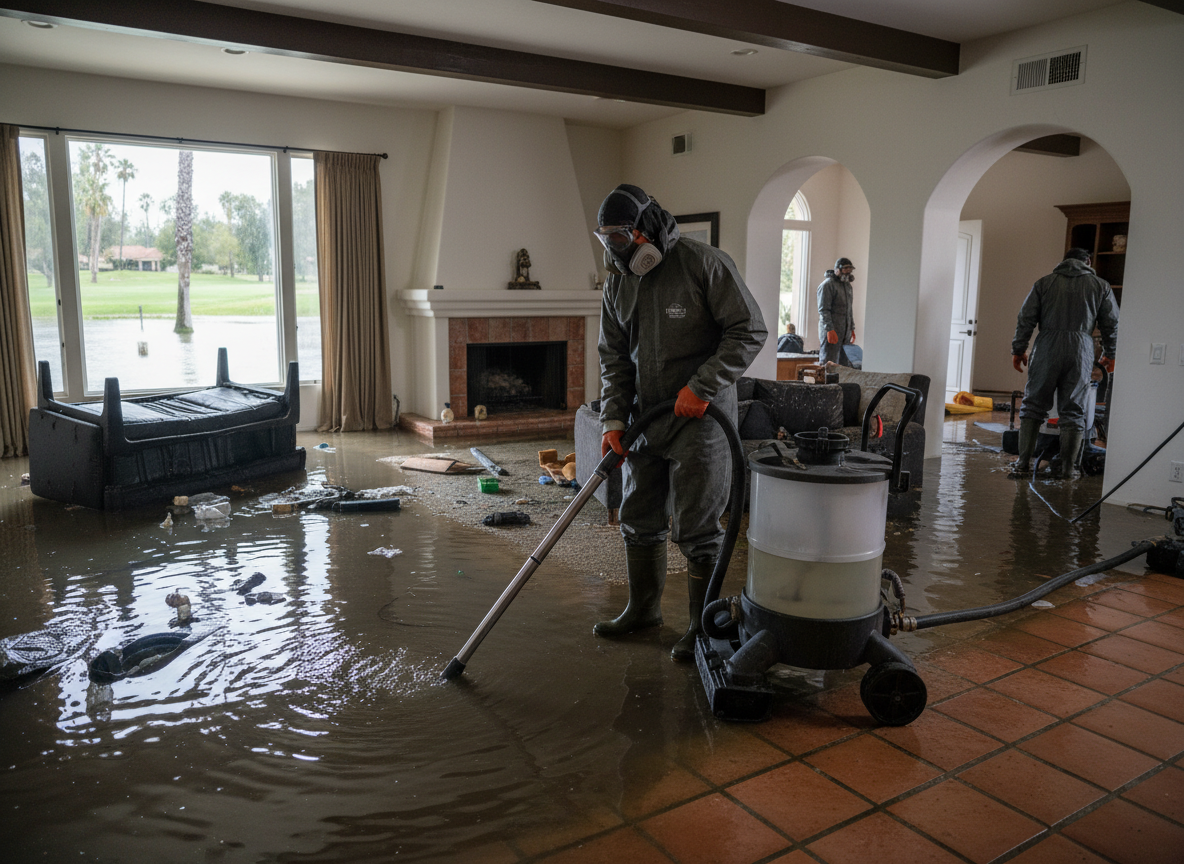
Laguna Woods sits in a mild Mediterranean climate where most rain arrives in concentrated winter bursts. These events often exceed the capacity of the older storm drains that serve Laguna Woods Village and the surrounding fairways of the Laguna Woods Village Golf Courses. Water backs up along the low-lying streets and finds its way under the slab foundations typical of the 1960s and 1970s housing stock. Once moisture reaches the underside of the concrete, it travels laterally through the porous soil and reappears inside closets or behind kitchen cabinets days later. Technicians familiar with the area know to pull baseboards early and place moisture meters on the slab itself rather than relying on surface readings alone.
Flood water here frequently carries fine silt from the golf course landscaping and decomposed granite from nearby hillsides. That sediment settles into carpet padding and the seams of laminate flooring, creating hidden reservoirs that standard extraction misses. In Laguna Hills homes just across the border the same silt load can clog dehumidifier coils within hours, slowing the drying process. Crews therefore stage air movers in a cross-pattern that forces air under cabinets and through toe-kick vents, then monitor relative humidity at multiple depths in the slab for several days. Orange County code requires that any electrical outlets below the flood line be inspected and often replaced before drywall restoration begins.
Homeowners sometimes attempt to dry the property themselves with box fans purchased at the local hardware store. This approach leaves moisture trapped between the subfloor and the original vinyl tile found in many Laguna Woods Village units. The trapped moisture later fuels mold growth along the expansion joints. Professional flood restoration includes removing the affected flooring sections, drying the joist bays from below when possible, and applying antimicrobial agents rated for porous materials. Final clearance testing is performed with both moisture meters and thermal imaging to confirm the slab has returned to its pre-loss equilibrium moisture content.
Technician insight
In Laguna Woods the thing that catches most people out with flood restoration services is how winter rain funnels along the golf course drainage swales and then sits against the slab edges of 1960s Laguna Woods Village homes. Homeowners see the carpet dry and assume the job is done, but the silt has already wicked under the vinyl and into the particleboard subfloor. We end up reopening finished rooms weeks later because the initial extraction never reached that layer.
Winter Rain Backup into Laguna Woods Village Unit
Heavy overnight rain overwhelmed the street drain behind a Laguna Woods Village home near the golf course. Water entered under the rear slider and wicked into the slab. We extracted standing water, removed saturated baseboards and sections of vinyl, then ran directed drying under the cabinets for five days. Daily meter readings confirmed the slab returned to normal moisture content before new flooring was installed.
How it works
- 1
Emergency Assessment
Arrive within hours, document water depth and source, and map moisture migration through Laguna Woods Village slabs.
- 2
Water Extraction and Sediment Removal
Remove standing water and silt-laden residue using truck-mounted equipment suited to the fine soils common near the golf courses.
- 3
Structural Drying and Monitoring
Place drying equipment in patterns that reach under cabinets and through slab joints, then log daily moisture readings.
- 4
Restoration and Clearance
Replace affected materials, treat for microbial growth, and verify the structure meets pre-loss moisture levels before final repairs.
Pricing
Upfront quotes after on-site inspection; scope depends on water volume, sediment load, and how far moisture has traveled under slabs.